
Enterprise-Grade Data Streaming, Fully Managed in Your Cloud
Run Kafka and Pulsar streaming in your own cloud account — data sovereignty and compliance with fully managed operations.
Multi-Cloud Freedom
Deploy in AWS, Google Cloud, or Azure. No vendor lock-in.
Cost-Efficiency
Eliminate inter-VPC egress and reduce cloud spend with in-cloud deployment.
Security & Compliance
Keep data in your own environment to meet regulatory requirements.
Trusted for mission-critical data and AI
• KEY BENEFITS
A Fully Managed Data Streaming Environment
BYOC (bring your own cloud) provides a fully managed data streaming environment that is compatible with both Pulsar and Kafka APIs:
Runs in Your Cloud
Deploy inside your own AWS, GCP, or Azure account.
Fully Managed Ops
We handle provisioning, 24/7 monitoring, upgrades, and patches.
99.99% availability SLA
Multi-zone deployments backed by a 99.99% availability SLA.
No External Dependencies
Data and metadata stay in-cloud; no single point of failure.
Data Never Leaves
Sensitive data and credentials remain within your environment.
BYOC Pro Option
Advanced controls tailored to your security and operational model.
• HOW IT WORKS
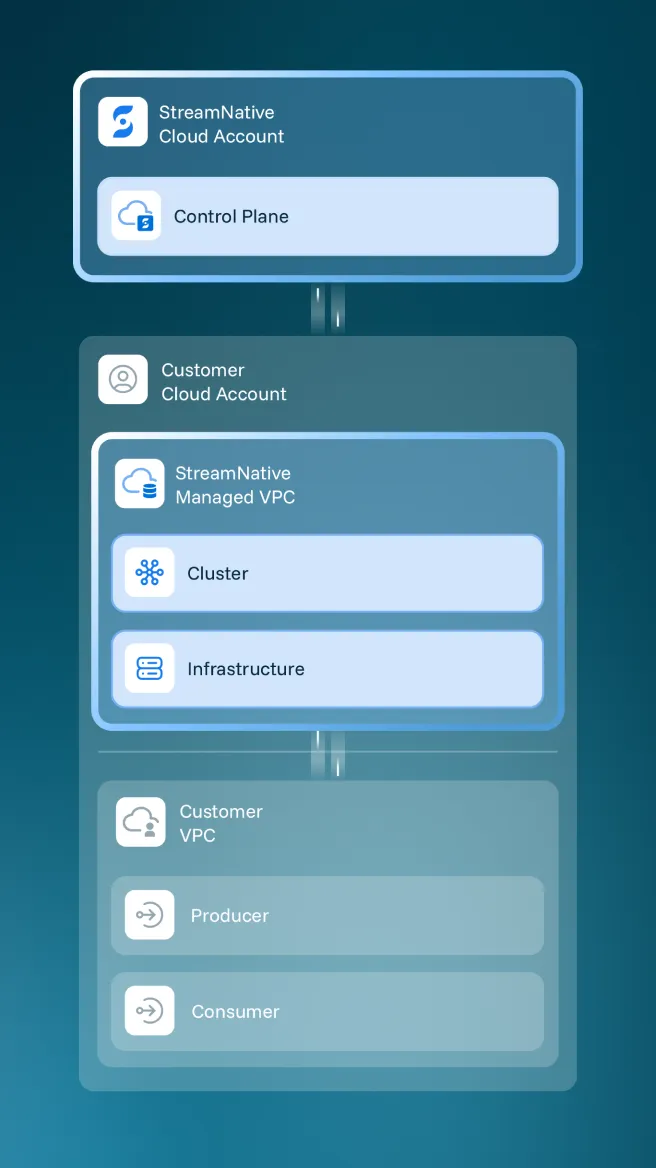
In a BYOC deployment, a Portable Data Plane is installed in your cloud account. StreamNative control plane orchestrates cluster operations and policy, while the data plane runs topics, consumer groups, connectors, and schemas.
Immutable Infrastructure
Define the data plane as code (Terraform + K8s) for rapid rebuilds and cross-cloud migrations.
Atomic Data Plane
Self-contained data plane with no single points of failure and a lightweight control plane for orchestration.
Decoupled Orchestration
Separate policy from runtime — operations stay resilient as clusters evolve, upgrade, or move across regions.
Open & Auditable
Open standards (IAM, K8s CRDs) with no closed-source agents — every change is visible and traceable.
Secure by Design
Least-privilege access with revocable control-plane permissions. Secrets stay in your cloud.
Full Metadata Control
Host metadata locally — workloads continue if the control plane is unavailable. No vendor lock-in.
How Does BYOC Compare to Other Deployment Options?
Compare BYOC with other StreamNative deployment options to find the best fit for your needs.
Find Out Why Our Customers Love Us

"Our journey with Apache Pulsar and the knowledge we have built together with StreamNative have helped us build a central messaging platform that powers the delivery of millions of packages."
René Laplaine, Manager IT Business Platforms at Intelcom
Customer since 2019

"We trust StreamNative to help us manage the entire lifecycle of data across our enterprise, which supports billions of e-commerce interactions across the globe. There's really no one ahead of StreamNative when it comes to unified messaging and streaming in the cloud."
Ankush Goyal, VP of Engineering at Narvar
Customer since 2019

"Pulsar is unique in that it covers many use cases, while also serving as a viable alternative to many technologies currently in use. It covers all of our use cases and lets us focus on building an excellent system."
Greg Methvin, Iterable
Customer since 2019
FAQs
Classic-Engine BYOC/BYOC Pro uses a resource-based model: Compute Units (2 vCPU, 8 GB RAM) for stateless components and Storage Units (2 vCPU, 8 GB RAM) for stateful ones—billed hourly. Ursa-Engine BYOC/BYOC Pro uses throughput-based Elastic Throughput Units (min 1 ETU), billed hourly by the highest of ingress, egress, or data-entries in that hour. Billing accrues hourly and is invoiced monthly; default subscription is Pay-As-You-Go.
StreamNative BYOC is available on AWS, Google Cloud, and Azure. You can deploy in any region supported by your cloud provider, giving you full control over data residency and latency requirements.
StreamNative collects operational metrics and metadata necessary to manage the platform. Your message payload data stays entirely within your cloud account. Access is controlled via cross-account IAM roles with least-privilege permissions that you can revoke at any time.
Your data plane continues operating independently. Producers and consumers keep running, messages continue flowing, and no data is lost. The control plane handles provisioning and configuration changes — if it's temporarily unavailable, your existing workloads are unaffected. The architecture isolates the blast radius so a control-plane issue never impacts your message traffic.
Yes. BYOC uses cross-account IAM roles with least-privilege permissions, and all access is logged in your cloud provider's audit trail (AWS CloudTrail, Google Cloud Audit Logs, Azure Activity Log). StreamNative is SOC 2 Type II certified, and you can review exactly what permissions are granted and when they are exercised.
Ready to Bring Your Own Cloud?
- Partner with StreamNative to take control of your data streaming journey today for enterprise-grade performance, compliance, and resiliency.
- Connect a couple of sources and sinks with UniConn, or link an existing Kafka cluster with UniLink.
- Deploy your first Orca agent on those streams and tools to see agentic AI on your own data.