On September 24, 2026, we announced the Stream Materialization Framework, introducing a common way to turn streams into governed, queryable data assets. Our announcement blog, Introducing the Stream Materialization Framework: From Streams to Governed Data Assets, explains the architecture and how materialization becomes part of the streaming platform.
With the framework already launched, this follow-up takes a closer look at the new destinations we have added: ClickHouse tables, MongoDB collections, and OpenSearch indexes. These expand the choices available alongside our existing support for Delta Lake and Apache Iceberg lakehouse tables.
Below, we walk through the existing and new destinations together—how topics become tables, collections, or indexes, what each destination enables, and when to choose it. Teams can select the destination that fits their analytics, application, or search workload while continuing to produce data to StreamNative topics.
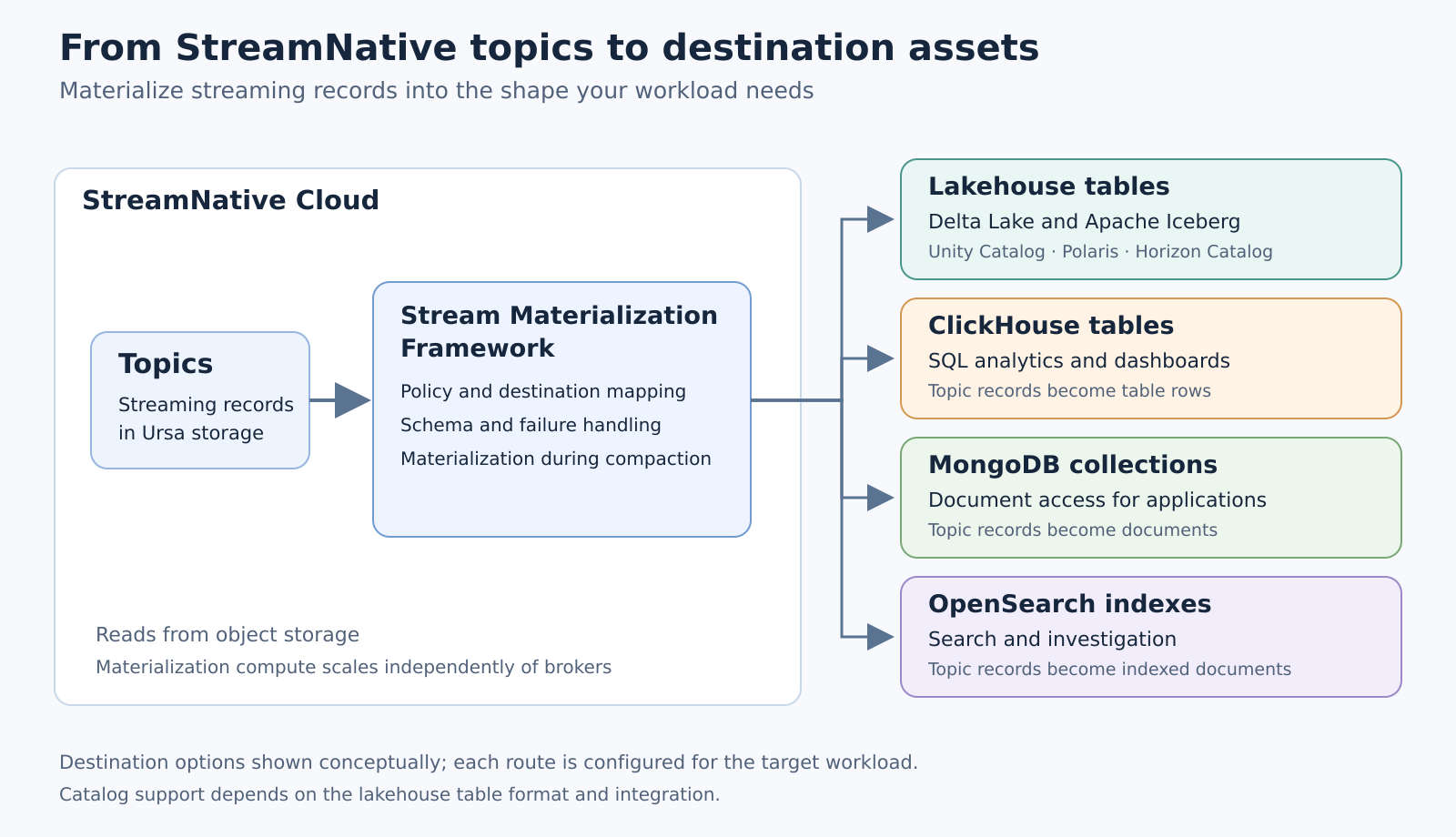
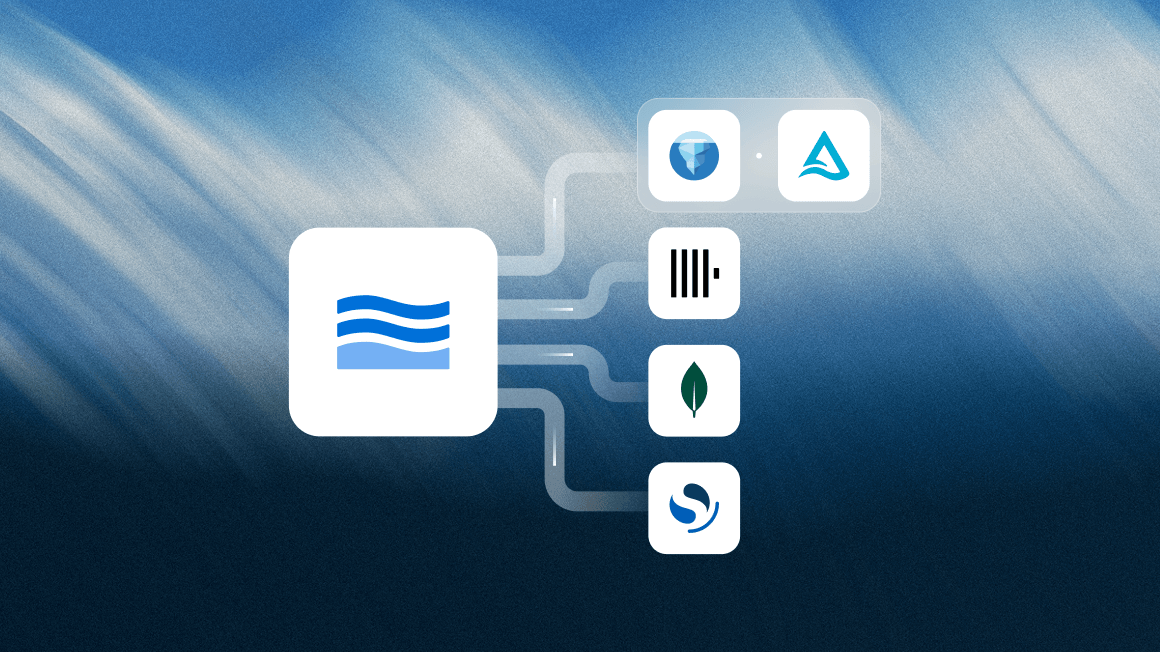
Figure 1: Topic materialization paths in StreamNative Cloud
How topics become destination assets
You select a topic and configure its materialization destination and target asset. A materialization policy declares the desired output. The destination materializer translates stream records into that representation and writes them to the target system.
In Ursa, this work runs during compaction, reading records from object storage rather than consuming them through the brokers. The framework provides shared machinery for schema mapping and evolution, retries, and dead-letter handling. Destination materializers use that machinery to create the appropriate tables, documents, or indexes.
This makes materialization part of the streaming platform rather than a separate connector runtime. The destination choice determines how downstream teams query and use the data. The diagram shows the available destination paths; it does not imply that a single topic is simultaneously materialized into every destination.
Lakehouse tables with Delta Lake and Apache Iceberg
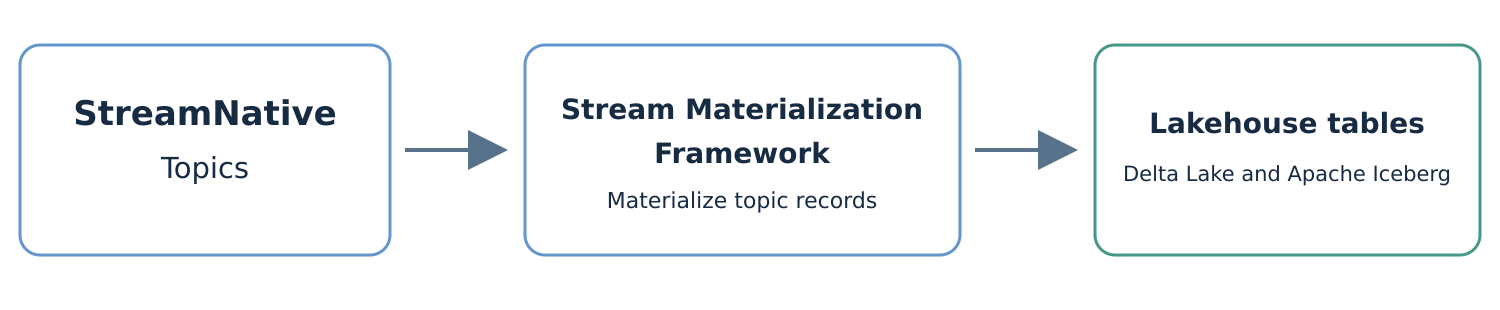
Lakehouse tables have been supported in StreamNative Cloud for some time. Topics can be materialized as Delta Lake or Apache Iceberg tables, making streaming records available for lakehouse analytics alongside other enterprise datasets.
Catalog integrations bring those tables into familiar discovery and governance workflows. Depending on the table format and integration, destinations include Databricks Unity Catalog, Apache Polaris, and Snowflake Horizon Catalog. The table holds the data; the catalog registers and manages its metadata. These catalog options are not interchangeable across every table format.
Choose lakehouse materialization when teams want to analyze event history, combine streaming data with business datasets, or prepare data for downstream analytics and AI workloads. For example, payment events can become an Iceberg table that an analyst queries alongside account and transaction history.
The value is continuity: teams keep producing to topics while analytics teams access the resulting tables through their lakehouse tools and catalog workflows.
Explore our lakehouse integration blogs for details on materializing topics as Delta Lake and Iceberg tables:
- Delta Lake with Unity Catalog: Seamless Streaming to Lakehouse: StreamNative Cloud Integrates with Databricks Unity Catalog
- Iceberg with Unity Catalog: StreamNative Expands Unity Catalog Integration with Managed Iceberg Tables
- Iceberg with Snowflake Open Catalog: StreamNative Enables Seamless Streaming into Apache Iceberg with Snowflake Open Catalog
ClickHouse tables for operational analytics
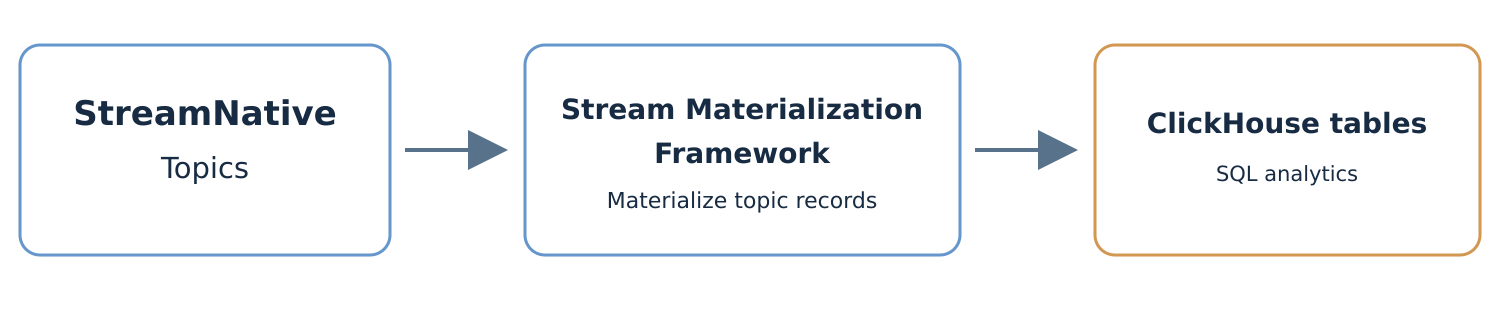
ClickHouse materialization turns topic records into rows in ClickHouse tables. ClickHouse is a column-oriented SQL database suited to analytical queries, making it a useful destination for teams building dashboards and exploring large event datasets.
Once records are materialized, teams can use ClickHouse SQL to filter events, group them by business dimensions, and calculate aggregates. The target table becomes the query surface for applications and dashboards that already use ClickHouse.
Consider a stream of payment events. A dashboard could query the ClickHouse table to compare transaction volume by region, summarize payment outcomes, or examine activity by merchant. Similar patterns apply to product usage, service telemetry, and customer-facing analytics.
Choose ClickHouse when the primary need is repeated analytical queries over event data. Materializing records into a ClickHouse table provides the input; teams can then build the queries and dashboards their workload requires.
MongoDB collections for application access
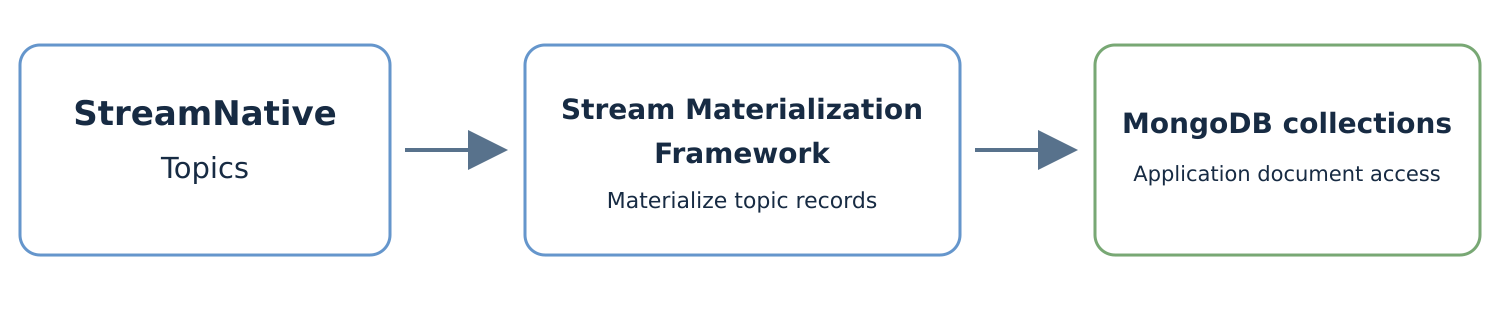
MongoDB materialization turns topic records into documents in MongoDB collections, making streaming data accessible to applications that already use MongoDB's document model and query APIs.
The integration supports three write modes to match different application needs:
- Append: Adds incoming records as new documents, ideal for event histories, activity timelines, and audit records.
- Upsert: Inserts new documents or updates existing documents based on a configured key, helping applications maintain the latest state of an account, order, or other entity.
- CDC: Applies change data capture events to reflect source data changes in the destination collection.
Developers can retrieve materialized documents using fields such as account ID, order ID, event type, or timestamp, with indexes designed for their application's access patterns.
For example, an application could use Append mode to display an order's event timeline, Upsert mode to maintain its current status, or CDC mode to keep a collection synchronized with changes captured from a source database. A customer support tool could then access these documents without consuming the topic directly.
Choose MongoDB when document access is the natural fit for your application. Append, Upsert, and CDC modes support both event history and current-state use cases, while more complex aggregations or derived views may require additional processing.
OpenSearch indexes for search and investigation

OpenSearch materialization turns topic records into searchable documents in an OpenSearch index. This destination makes streaming events available to workflows that depend on finding relevant records through text searches, field filters, and aggregations.
Security and operations teams can use the resulting index to investigate events in OpenSearch and build views in OpenSearch Dashboards. The index mapping determines how fields are interpreted and which searches they support.
For example, login events could be materialized into an index that an analyst searches by account, device, IP address, or time range. The analyst could investigate repeated failed logins followed by a successful login, then compare those events with other indexed security signals.
Choose OpenSearch when the main task is event discovery and investigation. Materialization supplies searchable records; correlation logic, alert rules, and any further enrichment are configured for the investigation workflow.
Getting Started
Ready to put your streaming data to work? Sign up for a StreamNative Cloud trial and explore the Stream Materialization Framework. Choose a topic and the destination that fits your workload—lakehouse tables, ClickHouse tables, MongoDB collections, or OpenSearch indexes—and start building your analytics, application, or search experience with streaming data. This functionality is currently in preview, so customers need to reach out to StreamNative to enable this functionality.