StreamNative Cloud brings together open connectivity, Apache Kafka and Apache Pulsar streaming, lakehouse-native storage, stream processing, continuous SQL, and governance to help organizations build Streamhouse architectures.
Today, StreamNative joined Aiven, Confluent, Redpanda, and Ververica as a founding member of the Streamhouse Working Group, a new industry initiative establishing an open, vendor-neutral definition for a data architecture built to power real-time applications, analytics, and AI agents.
The working group is based on a shared observation: organizations are converging on a common architecture for making the current state of the business continuously available wherever it is needed. Streaming technology is foundational to that architecture, but no single project, component, or vendor portfolio constitutes a Streamhouse on its own.
Streamhouse is open language for an architectural pattern the industry can develop together, while customers remain free to choose the open-source technologies and commercial products that best fit their needs.
Why Streamhouse, and why now?
Applications and AI agents increasingly need to do more than analyze what happened yesterday. They must recognize what is happening now, make decisions, and take action as business events unfold.
The models themselves are widely accessible. The harder problem is enterprise context: you cannot fine-tune your way out of not knowing today's numbers. Orders, payments, inventory, customer activity, security signals, and operational telemetry remain distributed across databases, applications, cloud services, event streams, and analytical systems. If that context is stale, fragmented, or difficult to govern, even the most capable application or agent cannot act reliably.
That context has to be fresh, governed, and reliable enough for production, all at the same time. Today, teams reach for one of two answers. They point agents at source systems, where the interface often doesn't exist, access is limited for good security and performance reasons, and internal schemas are hard to read. Or they point agents at the lakehouse, a good and safe answer, but one built for batch arrival, internal service levels, and analytical queries. Neither was designed to deliver all three at once.
A Streamhouse architecture addresses this challenge by continuously capturing, transporting, transforming, governing, and serving the current state of the business. The open definition centers on three attributes:
- Real-time: Data remains continuously current as business events occur rather than being refreshed only through periodic batch processes.
- Production-native: The architecture is engineered to production service levels because business-critical applications, analytics, and agents depend on it continuously.
- Decentralized: It meets data where it already lives rather than requiring all enterprise data to be consolidated into a single system first.
How we built our reference implementation
StreamNative Cloud is our view of a reference implementation of the Streamhouse architecture: one way to build it, not the only one. It provides an integrated set of capabilities across the core layers while preserving the open interfaces organizations already use. These are the principles we applied, from the foundation up.
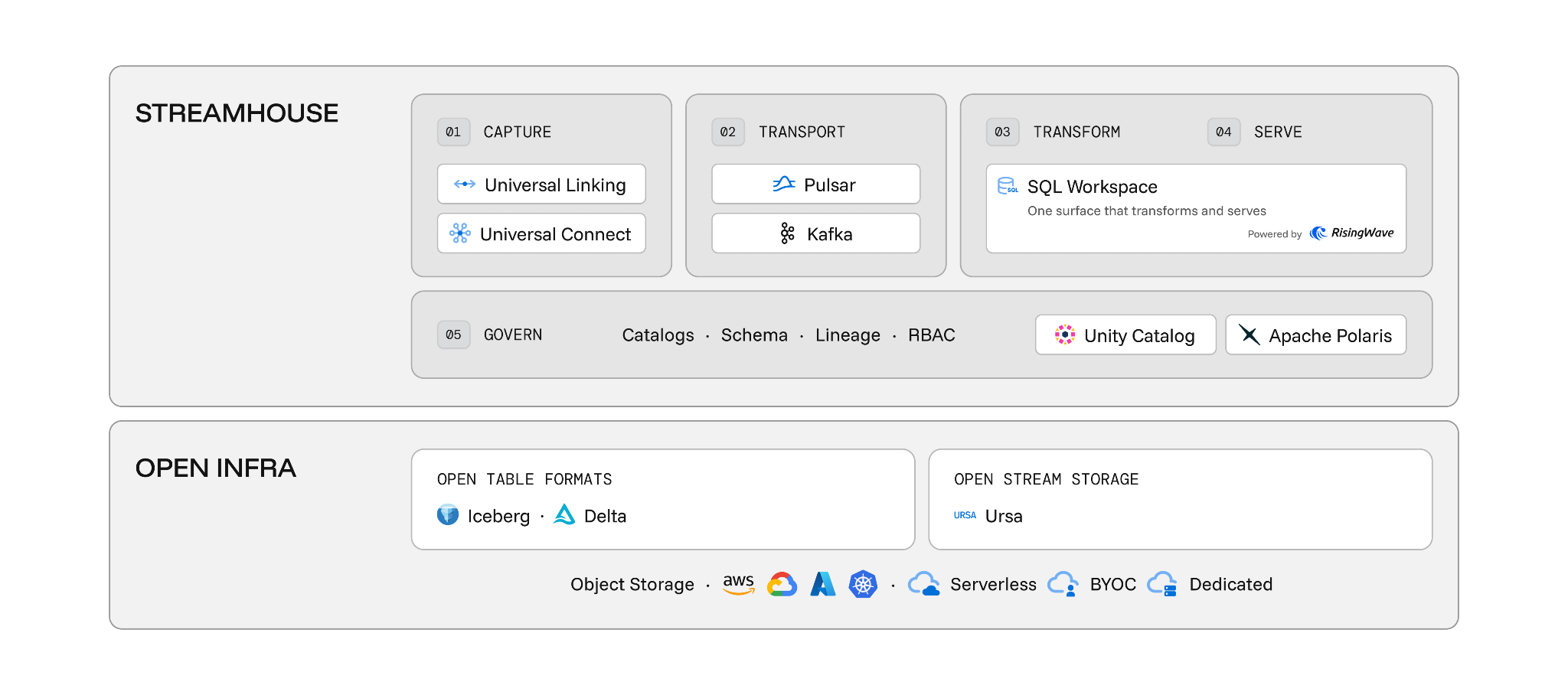
How StreamNative Cloud maps onto the Streamhouse architecture.
Start on the same ground as the lakehouse
Keep your lakehouse. A Streamhouse does not replace it: both stand on the same ground of object storage, open table formats, and catalogs, often in the same bucket. The lakehouse is data to analyze the business; the Streamhouse is data to run it. So we started by making streams first-class on that shared foundation, alongside tables.
The Lakestream architecture, with Ursa implementing its storage layer, connects streams directly with lakehouse storage. Events written to topics can be represented as Apache Iceberg or Delta Lake tables in object storage through StreamNative Lakehouse Tables. This makes operational data available to the broader data and AI ecosystem without maintaining a separate stream-to-table pipeline or creating another closed copy of the data. Open table formats allow the two worlds to exchange data rather than compete for ownership of it.
Put governance underneath
Fresh data is useful only when it can also be understood, trusted, and governed. StreamNative Cloud integrates streaming data with established catalog and governance ecosystems, including Databricks Unity Catalog, Snowflake Horizon Catalog, and Iceberg REST-compatible catalogs.
Because streams can be materialized in open table formats within customer-controlled object storage, organizations can apply familiar discovery, access-control, lineage, and audit practices to real-time data. Policy that lives in the foundation follows the data to every consumer, instead of becoming a new integration for each one.
Meet data where it already lives
Of the three attributes, decentralized matters most: nobody has time to consolidate everything before their agents need context. StreamNative's Universal Connect (UniConn) provides managed connectivity across databases, SaaS applications, logs, and other operational systems. It runs Kafka Connect and Pulsar IO connectors, including change data capture connectors, on one runtime, giving teams a practical way to bring continuously changing data into the platform without rewriting connectors or first centralizing it in a proprietary destination.
Universal Linking, now in Public Preview, uses Data Links and Schema Links to mirror data and schemas from existing Kafka environments into StreamNative Cloud without downtime, helping organizations adopt the architecture incrementally rather than through a disruptive migration.
Keep every interface open
At the center of StreamNative Cloud are native Kafka and Pulsar services running on the Ursa engine. Organizations can use the streaming protocol that fits their applications while operating on a common, cloud-native foundation. Because interoperability is solved in storage rather than by translating between protocols, the protocol becomes a choice of interface, not a choice of data silo.
The same rule holds across every layer:
- Streams speak Kafka and Pulsar.
- Tables use Apache Iceberg and Delta Lake.
- Queries use PostgreSQL-compatible SQL.
- Agents can connect through the StreamNative MCP Server.
This openness gives organizations the flexibility to combine StreamNative Cloud with the databases, processing engines, catalogs, analytical platforms, serving systems, and agent frameworks they already use.
Transform and serve continuously
Different real-time workloads require different kinds of computation. StreamNative Cloud supports Apache Flink, powered by Ververica and currently in early access, for sophisticated stateful stream processing, and Pulsar Functions for lightweight, event-driven transformations.
Now in Private Preview, SQL Workspace, powered by RisingWave, adds a PostgreSQL-compatible query and processing layer directly over streaming data. Topics appear as queryable sources, and materialized views continuously maintain derived state as new events arrive. A materialized view transforms and serves in the same breath. Teams can express joins, filters, aggregations, and other transformations in familiar SQL, then expose the results to applications, analytical tools, and agents through an open PostgreSQL interface.
Together, these options let organizations create continuously updated business views without forcing every team or use case into the same processing framework.
Building the category together
We would rather the industry share one category than argue over five vocabularies for the same architecture. As a founding member of the Streamhouse Working Group, we will collaborate with Aiven, Confluent, Redpanda, Ververica, customers, practitioners, and the wider data community to evolve the definition publicly and advance the open standards and interoperability practices behind it.
The Streamhouse name, coined by Ververica, is available for the industry to use under a binding trademark commitment, without permission or fees, giving the industry a shared language for discussing the real-time, production-native, and decentralized data foundation modern applications and AI agents require.
The future of enterprise AI will be determined not only by model intelligence, but by the quality, freshness, and governance of the context those models can access. StreamNative Cloud is designed to help organizations build that foundation using open technologies and the systems they already trust.
Learn more
- Learn how StreamNative Cloud supports Streamhouse
- Read the Streamhouse Working Group press release
- To explore the open definition and participate in the initiative, visit streamhouse.com.